

Intro
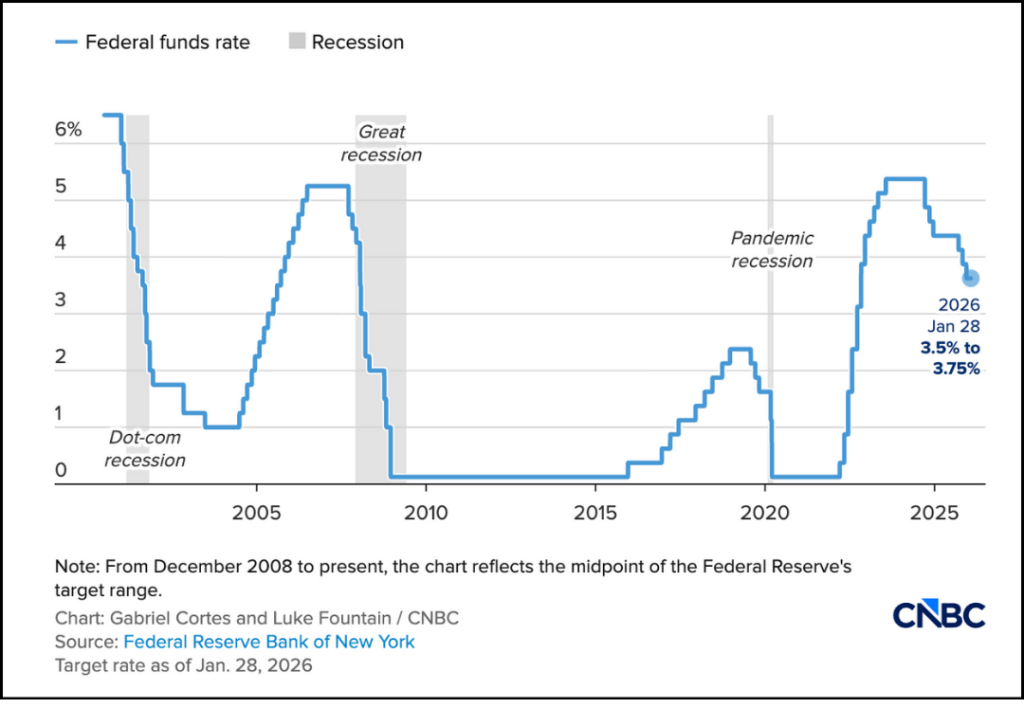
In the last two weeks, the tech sector experienced significant turbulence as AI-driven disruption fears led to sharp declines in stocks heavily exposed to private credit, while the Federal Reserve held interest rates steady at 3.5%-3.75%. Geopolitical developments also unfolded, with initial U.S.-Iran nuclear talks and strategic moves to reduce dependence on critical minerals from China. Let’s dive in!
ClariVise Insights
- AI Disruption in Tech: Stocks with heavy private credit exposure to software and tech sectors have fallen sharply due to fears of AI-driven disruption. The private credit market shows less diversification and higher risk than broader markets, highlighting the importance of general diversification amid tech stock declines.
- Fed Leadership Change: Kevin Warsh, expected to succeed Jerome Powell as Fed Chair, may support cutting interest rates, potentially easing borrowing costs. However, premature rate cuts while inflation remains high risk prolonging inflationary pressures, affecting investment and borrowing decisions.
- Fed Rate Pause: The Federal Reserve held its benchmark funds rate steady at 3.5%-3.75%, signaling a pause after three cuts. Chair Powell indicated no near-term easing, with steady economic growth, stable inflation, and muted labor market changes expected. Markets anticipate possible cuts later in 2026.
Other News
- Job Market Challenges: January 2026 saw the highest layoffs since 2009 with 108,435 cuts, while private payrolls added only 22,000 jobs. Initial jobless claims rose to 231,000 but remain near multi-year lows, highlighting ongoing labor market caution amid economic uncertainty.
- Future Fed Decisions: Fed Governor Miran supports over a one-percentage-point rate cut in 2026, viewing current policy as too tight and inflation as manageable. Such cuts could lower borrowing costs, potentially boost equity markets, and impact fixed income portfolios.
- Mortgage Rates: U.S. 30-year mortgage rates remain near 6%, showing little change as the spring home-buying season approaches. Federal Reserve interest rate pauses influence borrowing costs by affecting Treasury yields, providing a stable borrowing environment for potential buyers and refinancers.

- U.S.-India Trade Deal: The U.S. and India agreed to lower U.S. tariffs on Indian goods from 25% to 18%, while India will reduce tariffs on U.S. products to zero. India also committed to buying more American goods and to stop purchasing Russian oil, with potential purchases from Venezuela.
- Rare Earth Stockpile: President Trump is preparing Project Vault, a plan to build a strategic stockpile of critical minerals with $1.67B private capital and a $10B loan, aiming to reduce U.S. dependence on China for essential materials in EVs, defense, and technology sectors.
- Iran Talks: U.S. and Iranian diplomats held initial nuclear negotiations in Oman, marking a “good start” amid rising Middle East tensions. Low oil prices provide President Trump leverage in geopolitical actions, supported by expected global supply growth including increased Venezuelan production.

Earnings Spotlight
Planning Points
The Importance of Portfolio Rebalancing
Regular portfolio rebalancing helps maintain your desired risk level by realigning your investments to your original asset allocation.
- Asset allocation drift occurs when a portfolio’s mix of stocks and bonds changes due to differing returns, potentially making the portfolio riskier than intended.
- Rebalancing typically involves selling overweight assets that have increased in value and buying underweight assets that have lagged, promoting a disciplined buy-low, sell-high approach.
- Common rebalancing strategies include calendar-based (quarterly, semiannual, or annual), threshold-based (rebalancing when an asset class drifts by a set percentage), or a hybrid of both approaches.
- In taxable accounts, consider tax implications by using new contributions or tax-advantaged accounts to rebalance when possible to minimize realized gains.
- Even if a portfolio has drifted significantly toward stocks after strong market gains, it’s usually not too late to rebalance and bring the allocation back in line with your long-term plan.
Maintaining your intended asset allocation through regular rebalancing is a key practice to help manage risk and stay aligned with your financial goals. Consider reviewing your portfolio soon if it’s been over a year since your last rebalance.
Summary
Over the next two weeks, markets will closely monitor upcoming economic reports, particularly those concerning inflation and labor market dynamics, which could influence future Federal Reserve policy decisions. Additionally, investors will be watching corporate earnings reports and the market’s volatility, which could influence short-term market sentiment.
Footnotes
- Private credit stocks plummet on concern about exposure to software industry disrupted by AI (CNBC)
- What Trumps choice of Kevin Warsh for Fed chair may mean for consumers (CNBC)
- Here are the five key takeaways from Wednesdays Fed rate decision (CNBC)
- US saw pandemic-level layoffs in 2025, and 2026 job growth may be uncomfortably slow. What to do in a tough job market (Moneywise)
- Layoffs in January were the highest to start a year since 2009, Challenger says (CNBC)
- US weekly jobless claims increase more than expected (Yahoo Finance)
- Feds Miran calls for 1%+ in rate cuts in 2026, praises Warsh nomination (Investing.com)
- Average US long-term mortgage rate barely budges, holding near 6% (Associated Press Finance)
- Trump says U.S. and India reached trade deal, will lower tariffs immediately (CNBC)
- Rare earth miners jump as Trump is reportedly eyeing mineral stockpile to reduce China dependence (CNBC)
- Trump holds leverage over Iran thanks to low oil prices, Energy Secretary says (CNBC)