


Intro
In the last two weeks, key economic data showed the Federal Reserve’s preferred inflation gauge at 2.8%, signaling persistent inflationary pressures above target while consumer spending and economic growth demonstrated solid momentum. Meanwhile, significant geopolitical and policy developments have emerged, including a major US-Taiwan trade agreement and new legislative proposals to secure critical minerals. Let’s dive in!
ClariVise Insights
- Inflation Outlook: November’s PCE inflation rate held steady at 2.8%, slightly above the Federal Reserve’s target, signaling persistent price pressures. This supports expectations that the Fed may limit further rate cuts despite previous easing in 2025, balancing inflation risks with economic resilience.
- GDP Revision: The U.S. GDP grew at a revised 4.4% annualized rate in Q3, driven by consumer spending, exports, and business investment. Economists noted a K-shape pattern where higher-income households and big corporations are driving growth, while lower-income groups contribute less.
- Consumer Spending Strength: U.S. consumer spending rose 0.5% in both October and November, driving expected robust economic growth into a third consecutive quarter. This sustained spending supports market sentiment and may influence the Federal Reserve’s decision to hold interest rates steady.

What Else is in the News
- Personal Income Growth: U.S. personal income rose by $30.6 billion (0.1%) in October and $80.0 billion (0.3%) in November 2025, driven by higher compensation and government benefits, while personal consumption expenditures increased 0.5% each month. Personal savings rates slightly declined to 3.5%.
- Regional Diversification: Some investors are shifting away from U.S. mega-cap tech stocks toward international markets like Japan, China, and Europe, as well as U.S. small-cap and less tech-heavy indices, highlighting the importance of diversification across regions and sectors for portfolio resilience.
- Healthcare Spending: U.S. healthcare spending grew 7.2% to $5.3 trillion in 2024, driven by higher insurance enrollment and medical service use. Government admin costs, especially Medicaid, saw the largest increase, while hospital pricing and private insurance enrollment also contributed to overall growth.

- Critical Minerals Stockpile: A bipartisan U.S. bill proposes a $2.5 billion Strategic Resilience Reserve to stockpile critical minerals like lithium and rare earths. The fund aims to stabilize prices, support domestic mining, and reduce reliance on China by creating a market-insulated stockpile for defense and industry.
- US-Taiwan Trade: The US and Taiwan agreed to reduce tariffs on Taiwanese goods to 15% and secured $500 billion in semiconductor investments in the US, including $250 billion in direct investments and $250 billion in credit guarantees to expand tech operations and supply chains domestically.
- Greenland Deal: President Trump announced a NATO-backed framework addressing Arctic security and U.S. military access to Greenland but without transferring sovereignty from Denmark. Denmark and Greenland oppose any sovereignty change, and full negotiation details remain undisclosed.

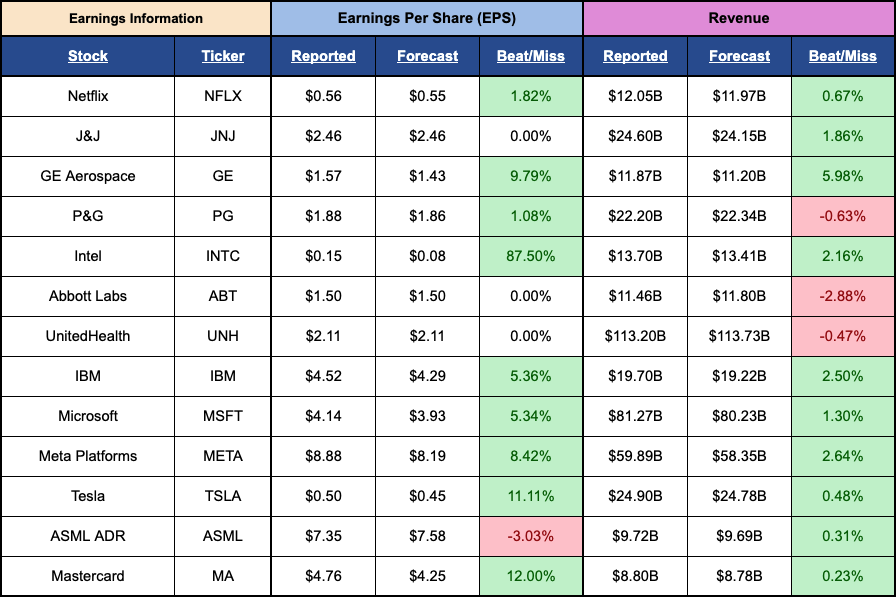
Earnings Spotlight
Planning Points
New $6,000 Senior Deduction Overview
Starting in tax year 2025 and lasting through 2028, individuals age 65 and older can take advantage of a new temporary senior deduction of up to $6,000 per person, potentially reducing taxable income by up to $12,000 for married couples filing jointly.
- This deduction applies regardless of whether seniors itemize or take the standard deduction, enhancing its accessibility.
- To qualify for the full deduction, modified adjusted gross income must be under $75,000 for singles or $150,000 for married couples; the deduction phases out at higher income levels.
- The deduction aims to offset taxes on Social Security benefits and applies more broadly to reduce taxes on various income sources.
- Careful tax planning during this four-year window can maximize benefits, such as managing income levels, retirement plan contributions, charitable giving, and timing IRA withdrawals.
- This opportunity provides seniors with significant tax relief during a period of high living costs and can complement strategies like delaying Social Security benefits to increase future income.
Understanding and integrating this deduction into your overall tax strategy can help make the most of this limited-time benefit.
Summary
Over the next two weeks, attention will turn to upcoming data releases on employment and manufacturing, providing further clarity on the labor market and industrial sector health. Additionally, U.S. lawmakers will advance legislation related to critical mineral stockpiles amid ongoing supply chain and national security considerations.
Footnotes
- Feds main gauge shows inflation at 2.8% in November, edging further away from target (CNBC)
- US third-quarter economic growth revised slightly higher (Investing.com)
- US consumer spending increases solidly in October and November (Investing.com)
- Personal Income and Outlays, October and November 2025 (BEA)
- Investors seeking diversification beyond U.S., Big Tech to begin 2026 – Barclays (Investing.com)
- US healthcare spending soars to over $5 trillion in 2024 (Investing.com)
- US lawmakers introduce bill to create $2.5 billion critical-minerals stockpile (Investing.com)
- US and Taiwan reach major trade deal with $500 billion investment (Investing.com)
- What are the details of Trump’s new Greenland ‘deal’? And why did he back down from acquiring the whole Arctic island? (Yahoo)